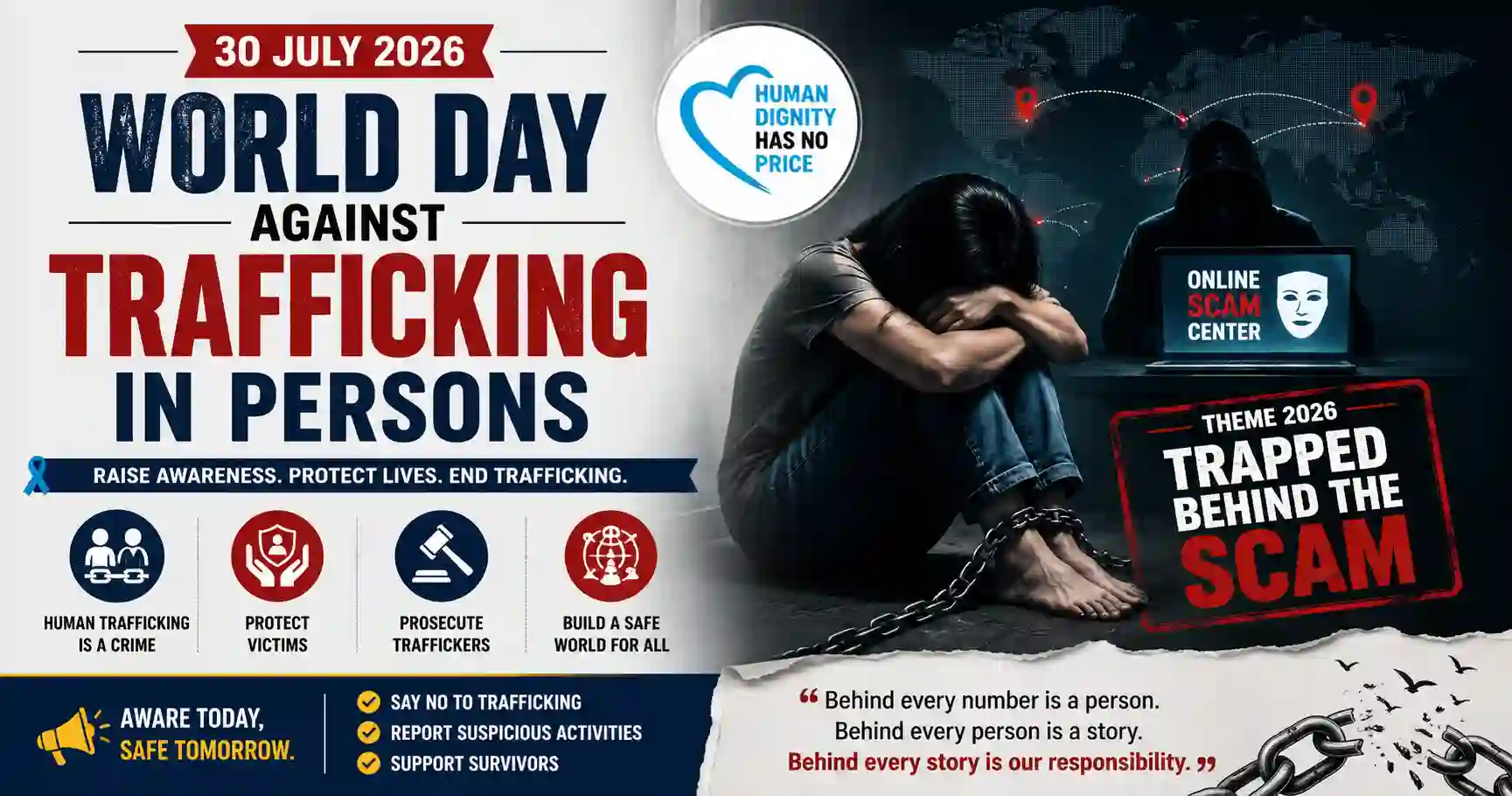
World Day Against Trafficking in Persons
World Day Against Trafficking in Persons is observed every year on 30 July to spread awareness about human trafficking, protect victims, and strengthen global efforts against trafficking networks.
The observance was established by the United Nations General Assembly in 2013 through Resolution A/RES/68/192 and has been observed annually since 2014.
What is Human Trafficking?
Human trafficking is the recruitment, transportation, transfer, harbouring or receipt of persons through force, fraud, deception or coercion for the purpose of exploitation.
Major Forms
- Forced Labour
- Sexual Exploitation
- Child Trafficking
- Forced Marriage
- Organ Trafficking
- Forced Begging
- Forced Criminal Activities
Latest Update (30 July 2026)
The official theme for World Day Against Trafficking in Persons 2026 is "Trapped Behind the Scam".
This year's campaign focuses on people who are trafficked into cyber scam compounds where they are forced to carry out online financial frauds, phishing attacks, investment scams and romance scams under threats and violence.
Why This Matters
- Highlights emerging cyber-enabled trafficking.
- Protects victims rather than criminalising them.
- Encourages international cooperation.
- Strengthens law enforcement against organised crime.
International Framework
The principal international treaty against human trafficking is the Palermo Protocol (2000), which supplements the United Nations Convention against Transnational Organized Crime.
India
- Bharatiya Nyaya Sanhita (BNS), 2023
- Immoral Traffic (Prevention) Act, 1956
- POCSO Act, 2012
- Juvenile Justice Act
- Bonded Labour System (Abolition) Act
Exam Importance
This topic is important for UPSC, State PSC, SSC, CDS, CAPF and other competitive examinations under Human Rights, Internal Security, Governance, Cyber Crime and International Organisations.